
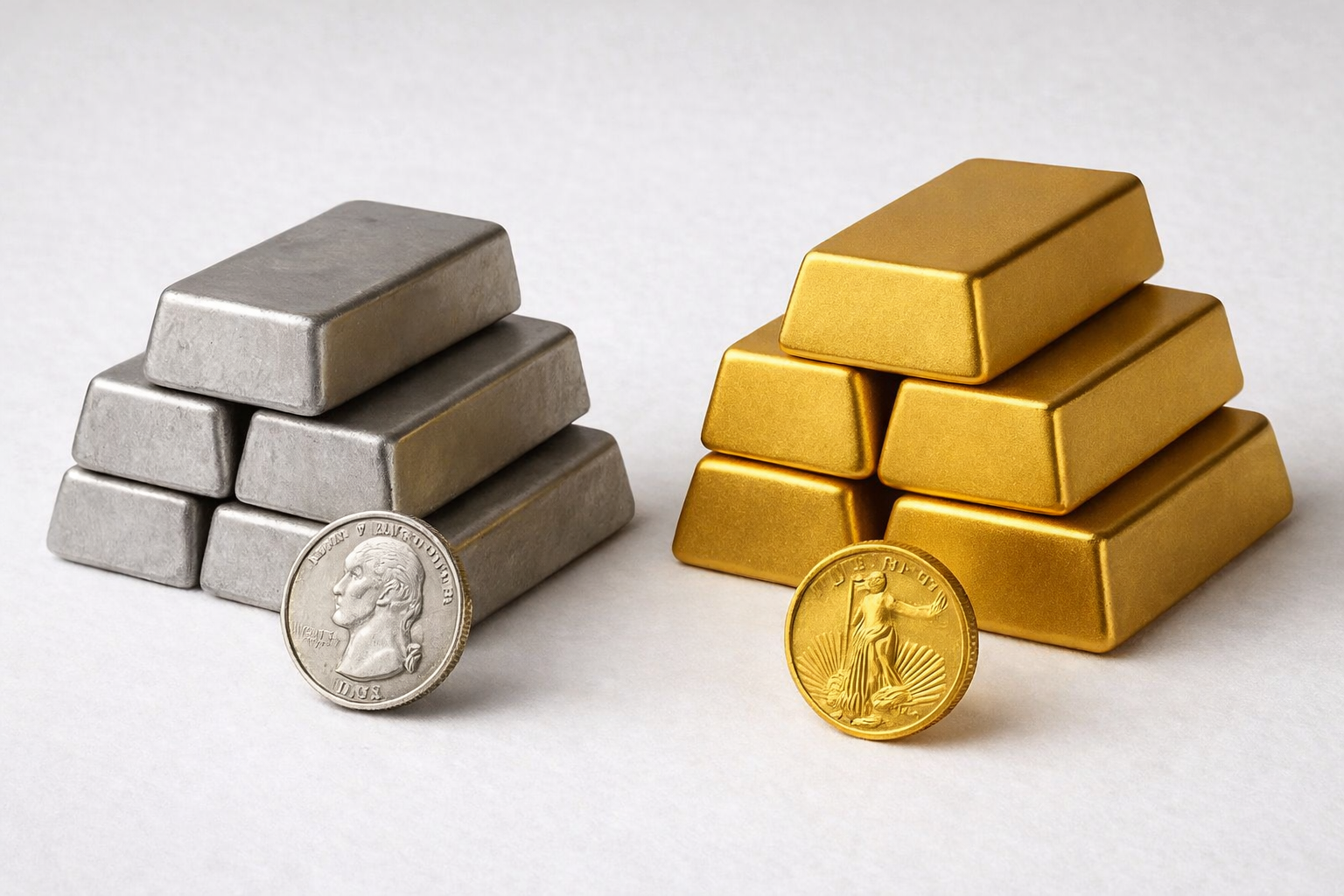
Gold just had its best year since 1979, rising from $2,606 to $4,310 in 2025, a 65 percent gain. Silver moved from roughly $30 to $72, up 144 percent. As of February 23, 2026, gold trades near $5,179 and silver at $86, with the gold-silver ratio collapsing from above 105 to 59. These are not normal moves, and calling it a simple “safe haven” trade misses the bigger shift that took place.
This was less about short term fear and more about structural repricing. Institutions were underweight, central banks kept buying, and monetary risk was reassessed against a backdrop of high debt, persistent deficits, and fragile credibility. Silver amplified the move as liquidity broadened. The rally was not just defensive positioning. It was capital rotating toward hard assets in a changing macro regime, and those structural forces have not disappeared.
Central banks didn’t just buy. They loaded up.
For three straight years (2022, 2023, 2024), central banks globally purchased over 1,000 tonnes of gold annually. That’s roughly double the pre-2022 run rate. Brazil alone added 43 tonnes in just three months through November 2025, bringing its total reserves to 172 tonnes. Poland, China, India — the buying was broad-based and deliberate.
J.P. Morgan projects roughly 755 tonnes of central bank gold purchases in 2026. That is lower than the recent 1,000 tonne pace, but it does not signal a retreat. At $4,000 to $5,000 per ounce, central banks need far fewer tonnes to achieve the same percentage shift in reserve allocations. The intent has not changed. The math has. When the price of gold rises, the volume required to rebalance reserves naturally falls, even if strategic demand remains intact.
What drove this? The honest answer is de-dollarization anxiety. Not the aggressive, flag-waving version you read about on financial Twitter — the quiet, institutional kind. Reserve managers at central banks in Brazil, Turkey, India, and across Southeast Asia spent 2022–2025 watching the U.S. freeze Russian dollar reserves, run fiscal deficits above $1.8 trillion annually, and apply political pressure on the Federal Reserve. They drew their own conclusions.
“Gold’s annual average price of $3,435/troy oz beat analyst consensus by 25.6% — the sharpest outperformance in the 20-year history of LBMA polling.”
— BullionVault / LBMA, December 31, 2025
Silver’s move was different — and arguably more interesting.
Silver’s 144 percent gain was not just leverage to gold. It was the collision of two distinct demand forces with a supply base that cannot respond quickly. On the industrial side, solar panels, EV batteries, AI data center electronics, and 5G infrastructure all require silver, with few viable substitutes. The Silver Institute estimates solar manufacturing alone consumed more than 200 million ounces in 2025, and that demand continues to rise.
At the same time, investment demand surged alongside gold as capital rotated into hard assets. Because silver’s market is much smaller, incremental flows had an outsized price impact. Supply, however, remained constrained. Global mine production has been essentially flat for more than a decade, hovering around 1.03 billion ounces in 2024 to 2025 versus 1.07 billion in 2010. Most silver is a byproduct of other metals, which means higher prices do not immediately translate into higher output.
The market ran an estimated deficit of 160 to 200 million ounces in 2025, marking the fifth straight year of undersupply, while inventories in London and on COMEX declined sharply. Citi has a $110 target for the second half of 2026 and BNP Paribas sees $100 as plausible. Whether those levels are reached or not, the structural imbalance between demand and supply remains unresolved.
The dollar story is what ties it together.
The U.S. dollar fell roughly 11 percent against major peers in the first half of 2025, its steepest drop in more than 50 years according to Morgan Stanley’s August 2025 analysis. The Fed cut rates three times, finishing the year at 3.50 to 3.75 percent, while political pressure on Jerome Powell’s Fed became increasingly public and fiscal deficits showed no signs of tightening. In that environment, gold’s role as a monetary hedge reentered the conversation.
Gold’s share of total global financial assets rose from about 2 percent to 2.8 percent through Q3 2025. That may sound modest, but J.P. Morgan notes it still reflects structural underinvestment relative to history. Most institutional portfolios entered 2025 with just 1 to 2 percent allocations, and many remain there. The rally was not crowded positioning unwinding. It was an underowned asset finally being repriced.
Primary Source
- BullionVault — Gold Silver Record Price 2025, Dec 31 2025 — bullionvault.com/gold-news/gold-price-news/gold-silver-2025-record-price-123120251
- J.P. Morgan Global Research — Gold Price Predictions 2026 — jpmorgan.com/insights/global-research/commodities/gold-prices
- J.P. Morgan Global Research — Silver Prices 2026 — jpmorgan.com/insights/global-research/commodities/silver-prices
- Fox Business — Gold Soars 66% in 2025, Jan 2 2026 — foxbusiness.com
- Newsweek — Gold and Silver Price Predictions for 2026, Dec 31 2025 — newsweek.com
- USAGOLD — Daily Silver Price History, Feb 23 2026 — usagold.com/daily-silver-price-history
- Kavout — Gold and Silver Price Forecast 2026 — kavout.com/market-lens/gold-and-silver-price-forecast-2026